The First Program of Many
With a resolution passed late last year, Purdue has become the first university in the United States to require every undergraduate to demonstrate "working competency" in artificial intelligence in order to graduate. Described as part of "an expanded partnership with Google", Purdue's decision marks a landmark shift in higher education curriculum design. Recently approved by the university's Board of Trustees as part of the AI@Purdue initiative, the decision will take effect for all undergraduate students entering in fall of 2026 and thereafter.
Under Purdue's "AI working competency" requirement, there's not a particular course that students must take to graduate; rather, students must demonstrate proficiency in knowledge and skills pertaining to AI embedded across their existing coursework and tailored to their discipline. For instance, engineering students might work with machine learning tools in design problems, while those studying literature may use natural language processing tools to analyze text. In any case, students of all majors at Purdue will demonstrate an understanding of how AI works and how to use it thoughtfully in their respective fields.
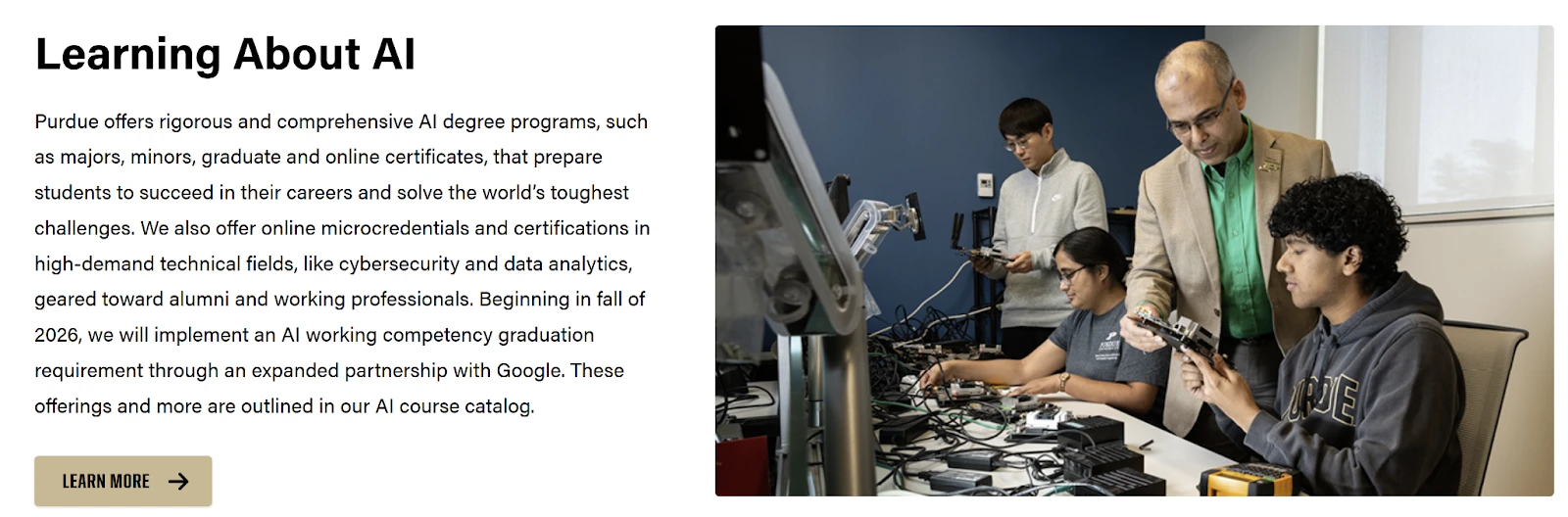
Details on the new requirement, as outlined on the Purdue AI website, are shown below:
What Students Will Learn About AI
Purdue's AI requirement falls across a few core areas:
Understanding and Using AI Tools
Students must identify what AI technologies can (and cannot) do, and how these tools might transform processes and problems in their chosen field.
Recognizing and Communicating About AI
This includes explaining decisions that involve AI, acknowledging limitations of the technology, and understanding the influence AI has in decision-making contexts.
Adapting to Future Developments
Because AI evolves rapidly, students will be expected to work effectively with new developments and maintain adaptability over time.
Purdue plans to embed this AI requirement into existing majors rather than make students complete extra credit hours. At the same time, faculty will develop discipline-specific criteria so the AI skills are meaningful within each academic context.
Why It Matters — and Why It Could Spread to Other Institutions
Purdue's move is significant for several reasons:
1. AI Is Becoming a Core Skill, Not Just a "Techy" Elective
As we've written on previously in our piece on AI and the Job Market, AI is primed to increasingly shape both professional contexts and societal systems. Whether you're looking at healthcare diagnostics, business analytics, creative industries, or anything in between, there's no doubt that AI is fundamentally altering how tasks are performed in these fields. Just as computer literacy has become an essential skill for students and employees alike in recent decades, AI literacy is now emerging as a foundational competency for those entering academic and professional ecosystems. Universities like Purdue are beginning to recognize this reality explicitly by instituting curriculum requirements rather than optional electives.
2. The AI Requirement Links Academic Learning with Practical Applications
Purdue's emphasis on practical competencies — not just theoretical knowledge — reflects the growing expectations of employers for graduates to be equipped with a robust, AI-enabled toolkit. This means being able to use AI tools thoughtfully, communicate about their use, and adapt their skillset as the technology evolves.
3. It May Set a Precedent for Other Institutions to Follow
While other universities, such as Ohio State with its AI Fluency initiative, have already integrated basic AI learning into the undergraduate experience, the formal graduation requirement implemented by Purdue creates universal accountability and ensures that all students achieve a baseline competency. Should this policy change yield graduates who are demonstrably more effective with AI tools in their careers, other universities may follow suit, especially as AI usage becomes more integral to these fields. That said, professors have raised concerns about how the requirement will be implemented in practice, its potential to impact faculty workload, the relevance it holds to Purdue's curriculum, and the risk of students taking shortcuts to fulfill their academic obligations.
How We Can Teach More About AI — and Why It Matters
While the effectiveness of the policy remains to be seen in its execution, there's no doubt that Purdue's requirement highlights a pressing need: students everywhere must understand not only how to use AI tools, but also how to think with them ethically and intelligently. This includes not just technical skills but logical reasoning, critical evaluation of AI outputs, and the ability to adapt to new AI developments, which are all areas that Purdue's embedded competency is designed to address. Such education is vital in order to help students use AI productively as a thought partner rather than relying on it as a high-powered tool to do the work for them.
At Grassroot, we see this same need in learners of all ages, not just in undergraduates at STEM-oriented universities. That's why our approach to AI in education includes:
- Structured learning that builds genuine understanding, not shortcuts
- Contextualized use of AI that encourages critical thinking
- Personalized course content that teaches students not just to use AI, but to use it wisely and ethically
Whether students are in college, high school, or lifelong learners, equipping them with a deeper understanding of AI's principles, applications, and limitations will prepare them for a world where AI is an inseparable part of work and life.
Looking Ahead at Grassroot
Purdue's move looks to be the first of many among academic institutions. As industries increasingly expect AI fluency in candidates, and as tools become more embedded in workflows, universities like Purdue that proactively integrate AI literacy into their curricula — whether through graduation requirements, embedded competencies, or tailored coursework — will help students enter the workforce with the relevant, practical skills they need to thrive in a rapidly changing professional context.
For families and learners watching this trend unfold, the message is clear: AI literacy isn't just a "nice to have"; it's rapidly becoming a core component of modern education, and we at Grassroot expect similar requirements to start popping up in universities across the country. That's why we're committed to preparing students right now with thoughtful, scaffolded AI learning experiences. From the way our tutors convey content to the intentional curriculum design of our AI coursework, Grassroot is designed as the ultimate learning partner to help ensure students are ready for the future of work and innovation.