Recent Developments
With each passing month, developments in AI continue to break new ground. During the past few weeks alone, OpenAI's video generation tool Sora 2 has taken over YouTube in a storm of 15-second clips, many including ridiculous deepfakes of celebrities and historical figures (picture Stephen Hawking riding a halfpipe or Nikola Tesla being crowned MMA champ), while Google's Gemini Enterprise is positioning the tech giant to compete with Microsoft's Copilot in firm offices around the world.
Do these developments mark the end of content creation (and other creative careers) as we know it? Are multinationals primed to downsize 90% by consolidating management and administrative functions into some kind of master technical suite reminiscent of something dystopian from Black Mirror? Though there's no shortage of speculation, ramifications of these recent developments in AI are wide-ranging, and the thoughts of many have continued to converge upon one fundamental question:
How will this affect the future of myself and my children?
Like most billion-dollar questions, this one isn't easy to answer, though there's no shortage of hypotheses. Some call the recent innovation in AI a fad, not unlike what was seen during the dot-com bubble, with developments anticipated to soon hit an immovable wall. Others posit that improvements in AI represent a change much more profound than what was seen in the advent of the Internet – the potential to not only automate routine tasks but to also redefine industries traditionally reliant on human creativity and intelligence.
Regardless of what the future of AI holds for the job market, it's best practice to be as prepared as possible. So, let's start by discussing which industries have been most affected by AI so far and which are posed for future disruption. Here we've shared two studies, both published this fall, which may shed some light.
What's Happened So Far?
What's undeniable is that AI has already disrupted the job market, and this is most apparent when examining new hire data. Erik Brynjolfsson and others at Stanford's Digital Economy Lab investigated how headcount has changed across multiple industries in the United States, standardized to data in October 2022 – right before the public release of ChatGPT. A figure from that study is presented below, examining two professions that have been affected in particular: software developers and customer service professionals.
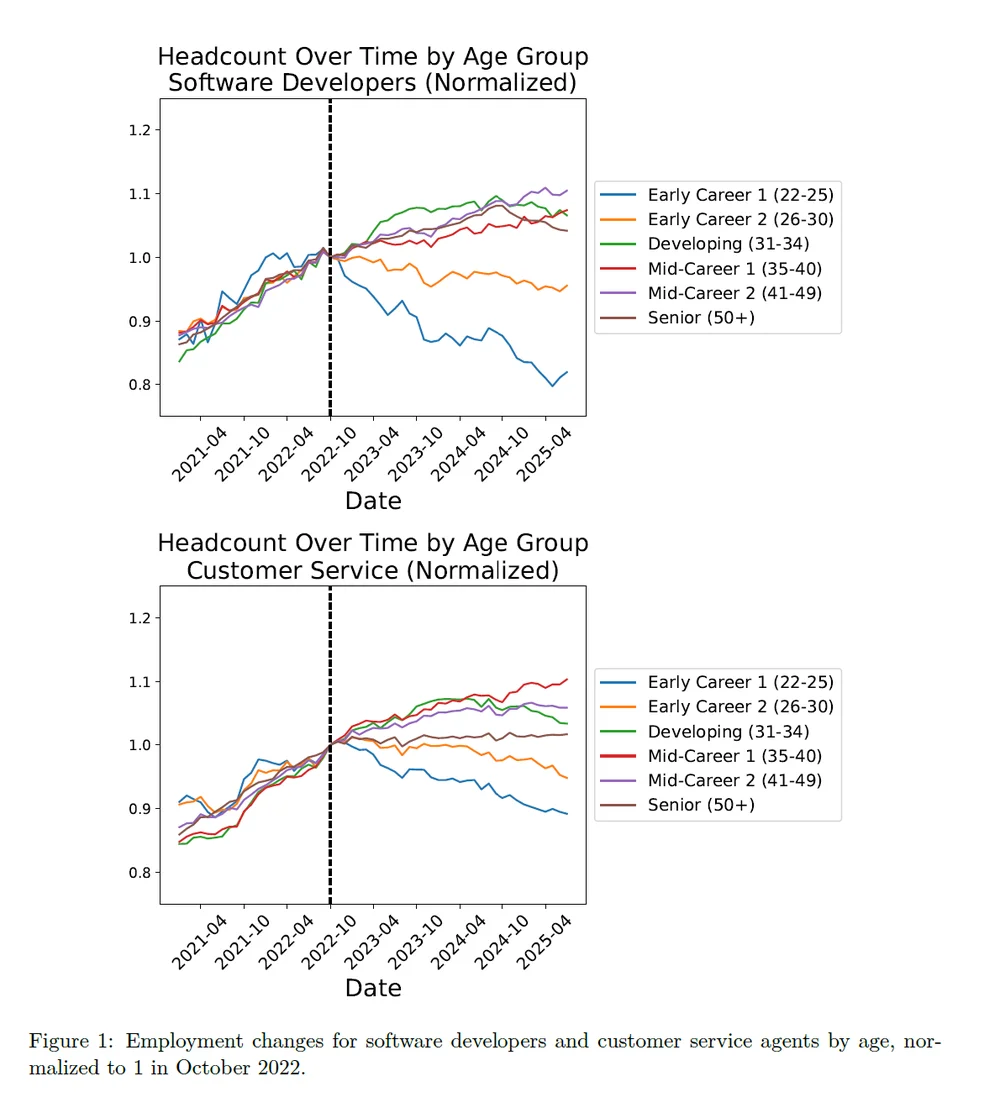
What jumps out is how much the blue line – composed primarily of fresh grads seeking their first full-time job – lags behind others further along in their career journey. In fact, Brynjolfsson reports a 13% employment decline in young people in these careers, relative to their peers – even after controlling for variables such as shocks that affect firm hiring across function. Bear in mind that this one-in-eight drop has been observed just over the past three years.
Perhaps more seasoned employees have been comparably more insulated than their younger counterparts on account of having developed more tenure with their firm — a reason that could also explain what's been seen in service professionals. There is also the possibility that the tasks traditionally formed by the youngest cohort, being relatively less complex than those of senior counterparts, are more easily replicable by AI automation.
Regardless of the reasons behind this shift in headcount away from fresh grads, the implications are clear: even as firms such as tech giants continue to grow in revenue and set new highs in market capitalization, many are hiring fewer young people. The "learn to code" mantra that proliferated just a few short years ago across social media has taken on a tone more reminiscent of gallows humor as many companies are openly using AI tools for development, leaving would-be engineers competing for fewer opportunities.
The data may not look great for those seeking to become software engineers or service professionals, but let's examine some more numbers on how the wider job market may look in the future as AI continues to expand in influence.
What's Next?
While it's clear that there has already been a significant reduction in hiring across a few industries, what does that mean for the future? What about employees in other industries, who face risk from AI that is less obvious?
Martha Gimbel and others at Yale University's Budget Lab investigated how employees across almost two-dozen industries rely on Claude and ChatGPT (LLMs developed by Anthropic and OpenAI, respectively) to obtain an estimate of AI usage and exposure by career. Here, exposure is measured by how the utilization of ChatGPT could cut the time it takes to perform a career function in half – which presents implications for job security (or lack thereof).
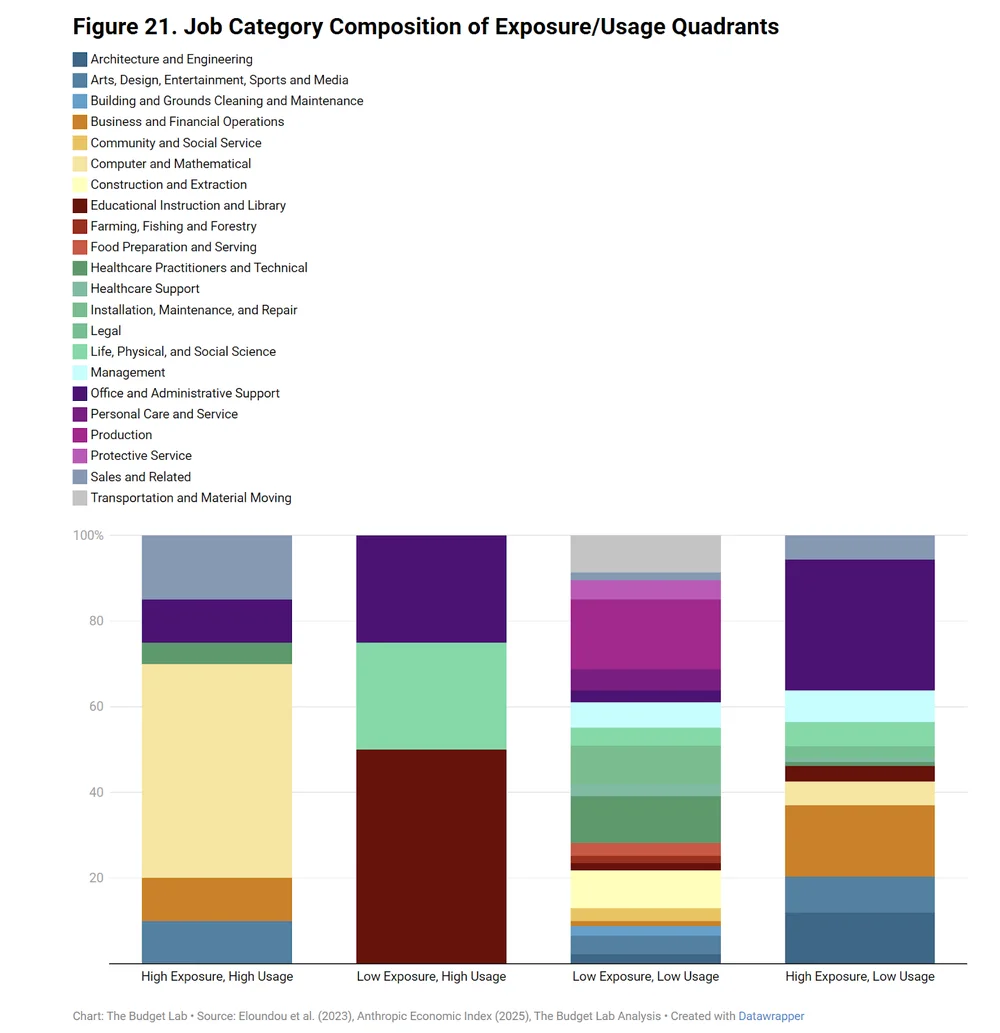
Using the data they collected on these LLMs, the Yale team categorized the twenty or so career areas they examined into four quadrants, differentiated by their usage and exposure. That figure is presented below.
Think of the quadrants like this:
- Quadrant 1: folks here use AI extensively on the job already and face great risk of career disruption
- Quadrant 2: despite their high use of AI, those in this group appear more insulated to career disruption
- Quadrant 3: folks in this group neither use AI much in their careers, nor face great risk of disruption at the moment
- Quadrant 4: though they do not use AI extensively on the job, those here face risk of career disruption by AI
Immediately obvious in the first quadrant – defined by high exposure and high usage – are computer-based careers. This shouldn't come as much of a surprise, given what we've seen in the Stanford study; code-writing is not a particularly difficult task for AI tools to perform, and considering high LLM usage in these careers already, existing employees may face a difficult job market in the future. Even careers heavily represented in quadrant 4, such as office and administrative support – whose employees do not express high usage of AI – face vulnerability due to the relative ease at which AI can automate related tasks.
By contrast, educational careers dominate quadrant 2; sure, many teachers use AI for classroom instruction, but they are comparatively more insulated, likely because of the human component present in teaching. Quadrant 3, characterized by both low usage and low exposure, unsurprisingly possesses a great mix of jobs heavily reliant on human labor. Those in trades such as production, installation, and construction have little use for an LLM in their day-to-day job and likewise currently experience low exposure to AI replication.
While the above chart is certainly a nice visual snapshot of which careers are expected to be more or less at risk as AI continues to develop, the authors admit the study's limits; ChatGPT and Claude are imperfect proxies to assess exposure and usage, and of course, the true degree of exposure is difficult to ascertain. Still, it may be worth digging into these studies further to see what the data suggests for the career(s) of your interest.
So, What's the Plan?
By diving into a clearer — albeit imperfect — picture of what sectors of the job market are primed to face risk of AI disruption, we hope you'll be better equipped for navigation throughout your career journey. Nonetheless, we here at Grassroot recognize that everyone has unique talents, skillsets, and passions that can — and should — play a role in the career exploration process. After all, who wants to choose a role based solely on its probability of being made redundant by AI?
The future is impossible to predict; there are even careers that don't yet exist, whose advent will undoubtedly complicate the preliminary analysis available to us now. What is possible, however, is undertaking preparation to best position yourself in the job market in this age of AI, irrespective of career. Stay tuned for next week's piece, when we'll dive into strategies you can employ to maintain your competitive edge throughout your career journey.
Sources
Brynjolfsson, Erik, et al. Canaries in the Coal Mine? Six Facts about the Recent Employment Effects of Artificial Intelligence, 26 Aug. 2025, digitaleconomy.stanford.edu/wp-content/uploads/2025/08/Canaries_BrynjolfssonChandarChen.pdf.
Gimbel, Martha, et al. "Evaluating the Impact of AI on the Labor Market: Current State of Affairs." The Budget Lab at Yale, 1 Oct. 2025, budgetlab.yale.edu/research/evaluating-impact-ai-labor-market-current-state-affairs.