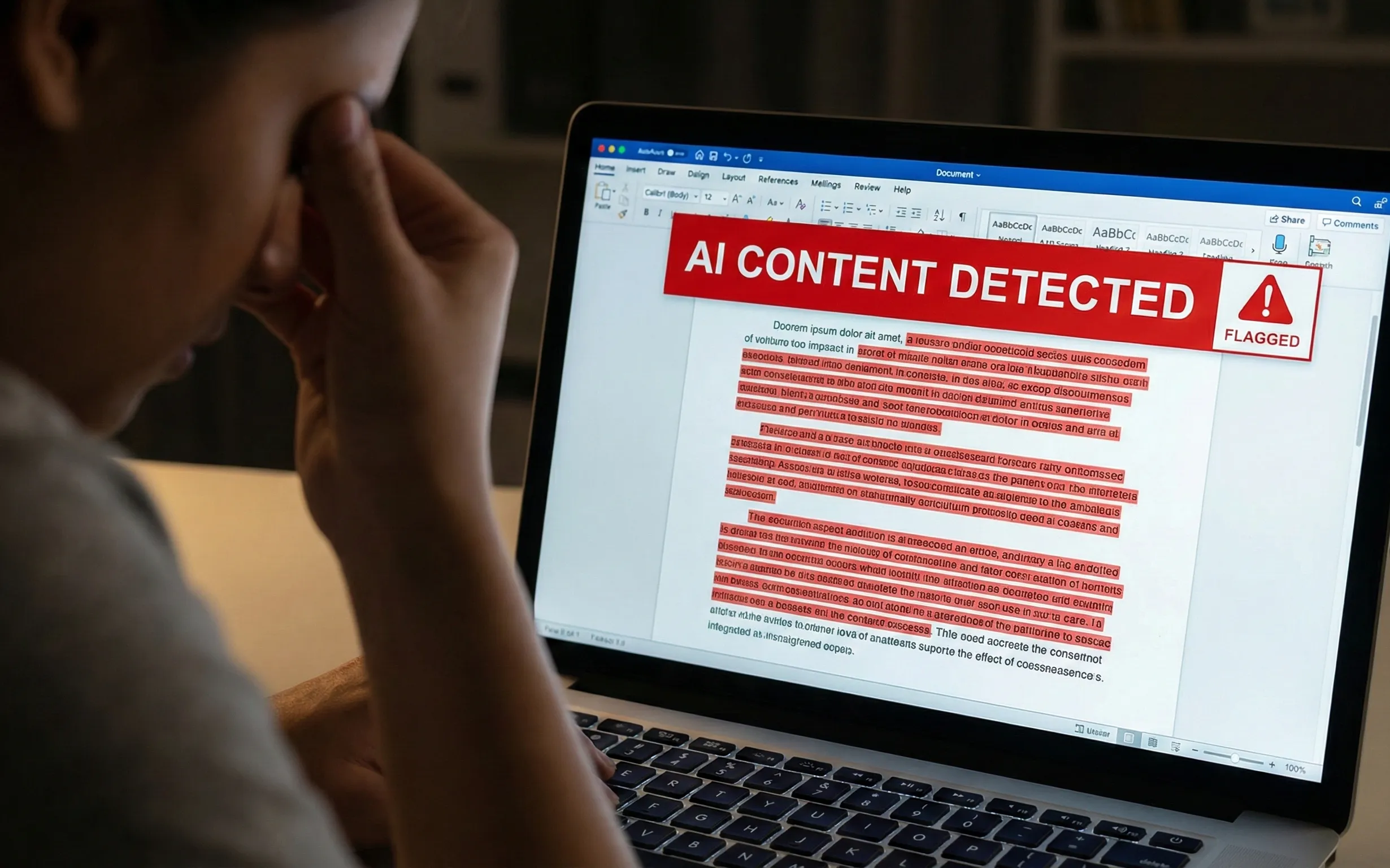
Half of all students worry about being wrongly accused of AI cheating. If it happens to you, here’s the data, the stories, and the steps that actually help.
This Is Happening More Than You Think
Let’s start with the numbers, because they’re kind of wild.
According to a 2025 RAND study, half of all students say they’re worried about being falsely accused of using AI to cheat. Not worried about getting caught—worried about being accused when they didn’t do anything wrong. And given what’s happening across schools and universities right now, that fear is completely justified.
Over 40% of teachers in grades 6–12 used AI detection tools last school year. These tools—Turnitin, GPTZero, Copyleaks—scan your essays and spit out a percentage that supposedly tells your teacher how likely it is that AI wrote your work. And schools are making real decisions based on those numbers: docked grades, academic misconduct hearings, even suspensions.
The problem? The tools aren’t nearly as accurate as everyone assumes.
The Detection Tools Are Getting It Wrong—A Lot
Here’s what the research actually shows: independent analyses have found that AI detection tools produce false-positive rates between 5% and 20%. That means for every 100 papers written entirely by real students, up to 20 could be wrongly flagged as AI-generated.
Think about what that means at scale. If your school runs a few thousand papers through Turnitin in a semester, hundreds of students could be incorrectly flagged. And once you’re flagged, the burden of proving your innocence usually falls on you.
This isn’t hypothetical. It’s already happening to real students:
Ailsa Ostovitz, a 17-year-old junior in Maryland, was accused of using AI on three separate assignments across two different classes in a single school year. One of those assignments? A writing piece about the music she listens to. An AI detection tool flagged it at roughly 31% probability. She told NPR: “I write about music. I love music. Why would I use AI to write something that I like talking about?” She messaged her teacher asking them to try a different detector. The teacher never responded and docked her grade.
Kelsey Auman, a student at the University at Buffalo working toward becoming a doctor, was accused of academic integrity violations on multiple assignments in April 2025. Turnitin’s AI detector flagged her work—even though she wrote everything herself. Her assignments were formulaic by design (a review, gap analysis, and grant proposal), which is exactly the kind of writing AI detectors tend to misidentify. She eventually cleared her name by showing her browser history and research process, but the damage was done. She started a petition to stop her university from relying on Turnitin’s AI detection.
A nursing student at Australian Catholic University named Madeleine had her entire final year disrupted after Turnitin flagged her work. She had to wait six months before the accusations were dropped, and during that time her transcript was marked “results withheld.” She says that’s part of why she wasn’t offered a graduate nursing position. The university reported nearly 6,000 cases of alleged cheating in 2024, with about 90% of them related to AI use.
And one that made national headlines: a student has sued Yale University after being accused of using AI on a final exam in their Executive MBA program. Yale flagged his exam using GPTZero. The case, which could set precedent for how universities handle AI accusations going forward, is currently being litigated in federal court.
Why These Tools Fail
AI detectors work by analyzing patterns in your writing—things like sentence structure, word choice, and predictability. If your writing is “too” polished, consistent, or structured, the detector may assume a machine wrote it.
The obvious problem: plenty of humans write clearly and consistently. And certain types of students get hit harder than others.
A Stanford University study found that AI detectors frequently misclassify essays by non-native English speakers as AI-generated. The reason? Non-native speakers often use simpler, more structured phrasing—the same patterns that AI tends to produce. Researchers at the University of Nebraska-Lincoln found a similar bias against neurodivergent students (including those with ADHD and autism) who may naturally write in more formulaic or direct ways.
Even Turnitin itself acknowledges the limitations. On its own website, the company states that its AI detection tool “may not always be accurate” and “should not be used as the sole basis for adverse actions against a student.” And yet, that’s exactly what many schools are doing.
Mike Perkins, a researcher on academic integrity at British University Vietnam, tested several of the most popular AI detectors and found that their accuracy dropped significantly when AI-generated text was even lightly edited. He told NPR that there are “really concerning problems with some of the most prolific AI text detection tools.”
What to Do If You Get Accused
If it happens to you—and statistically, it could—here’s what actually helps.
Don’t panic, and don’t admit to something you didn’t do. The emotional response is understandable, but making statements out of frustration can complicate things. Take a breath and approach it methodically.
Gather your evidence immediately. This is the single most important thing you can do. Pull together anything that shows your writing process: Google Docs version history (which timestamps every edit), browser history showing your research, handwritten notes or outlines, earlier drafts, even screenshots of your research tabs. The more you can demonstrate how you wrote the piece, the stronger your case.
Know your school’s policies. Look up your school’s academic integrity process in the student handbook. Understand what your rights are—most schools guarantee you the right to present evidence and respond to accusations before any penalty is applied. If your school’s entire case rests on a single AI detection score, that’s worth pushing back on.
Ask what evidence the school is using. If the only basis for the accusation is a Turnitin or GPTZero score, point to the fact that even these tools’ own creators say they shouldn’t be used as the sole basis for disciplinary action. Ask your teacher or school to consider your evidence alongside the detection score, not instead of it.
Write in Google Docs going forward. Seriously, this is the easiest preventive step. Google Docs automatically saves a detailed version history that shows exactly how your document evolved over time—every keystroke, paste, and edit is logged. If your work is ever questioned in the future, you’ll have a complete record of your writing process ready to go.
The Bigger Problem Nobody’s Talking About
Here’s the thing that gets lost in all the accusation drama: almost everyone is using AI for school now.
A 2025 study by the Higher Education Policy Institute found that 92% of students use AI tools in some capacity—up from 66% just a year earlier. College Board research found that 69% of high school students specifically reported using ChatGPT for school assignments. This isn’t a fringe behavior. It’s the norm.
But schools haven’t figured out how to distinguish between students who are using AI to skip learning and students who are using AI to support learning. And that distinction matters enormously.
Copying and pasting a ChatGPT response into your essay and submitting it as your work? That’s clearly a problem—not because you used technology, but because you didn’t actually engage with the material. You didn’t learn anything.
Using an AI tool to help you break down a confusing concept, quiz yourself before a test, or check whether your understanding of a topic is on track? That’s studying. That’s what good students have always done—they just used to do it with textbooks, flashcards, and office hours.
The problem is that raw AI tools like ChatGPT don’t care which one you’re doing. They’ll happily write your entire essay or patiently explain cellular respiration to you—they make no distinction. And when everything goes through the same tool, teachers can’t tell the difference either.
There’s a Better Way to Use AI for School
This is exactly why we built Grassroot.
Grassroot isn’t ChatGPT. It’s an AI tutor—specifically designed to help you actually learn rather than just hand you answers. When you bring a tough calculus problem or a confusing biology concept to Grassroot, it doesn’t spit out the solution. It walks you through the thinking. It asks you questions. It figures out where you’re stuck and explains things in a way that makes sense to you.
That means the work you produce is genuinely yours. Your understanding is real. And you don’t have to worry about an AI detector flagging your essay, because you actually wrote it—Grassroot just helped you understand the material well enough to do it confidently.
We built Grassroot because we’ve been on both sides of this. Our team includes first-generation college students, international scholars, and competitive academics who’ve experienced how the right support at the right time can change everything—and how unfair it is when that support isn’t available to everyone.
If you’re a student trying to navigate AI without crossing a line or getting wrongly accused of crossing one, you’re not alone. And there are tools designed to keep you on the right side of that line while still giving you the support you need. Grassroot is one of them.
Ready to learn with AI the right way? Grassroot helps you understand the material so the work you submit is genuinely yours. Start learning →
Sources
- RAND Corporation. “AI Use in Schools Is Quickly Increasing but Guidance Lags Behind.” September 2025.
- College Board Newsroom. “New Research: Majority of High School Students Use Generative AI for Schoolwork.” May 2025.
- Higher Education Policy Institute (HEPI). “Student Generative AI Survey 2025.” February 2025.
- NPR. “Teachers are using software to see if students used AI. What happens when it’s wrong?” December 2025.
- NBC News. “To avoid accusations of AI cheating, college students are turning to AI.” January 2026.
- Futurism. “University Using AI to Falsely Accuse Students of Cheating With AI.” October 2025.
- Crowell & Moring LLP. “Ivy League Lawsuit Centers on Alleged Impermissible Use of AI in Academia.” 2025.
- Spectrum News. “UB student: False accusation over AI use inspired petition.” May 2025.
- Nesenoff & Miltenberg LLP. “When AI Gets You Accused: What to Do if Your School Says You Used ChatGPT.” November 2025.
- Newsweek. “Number of Students Using AI for Schoolwork Surges by Double-Digits.” July 2025.