Holiday season is upon us, and aside from all the great gifts, food, and of course, family time that it brings, there's another reward for millions of busy students: a well-deserved break.
Students need rest. Without adequate time to recharge and step away from structured schedules, they risk burnout, with potential detriments to physical and mental health. On the other hand, however, there is the danger of losing momentum on account of weeks without learning — especially when screentime can easily replace genuine curiosity.
There's some good news, though. Learning doesn't have to stop over breaks — it just needs to adapt modalities. Research has increasingly demonstrated that unstructured, self-directed time can play a critical role in cognitive development, especially when learners are supported — not pushed — to explore, ask questions, and think independently.
Unstructured Time Is Not "Lost Time"
When we think of learning, we often imagine classrooms, textbooks, and tedious homework assignments. But much of how learners develop problem-solving skills, creativity, and confidence happens precisely outside the rigidity of traditional academic structures.
Unstructured learning — where students are empowered to choose what they explore, how they approach their subjects of interest, and when to persist or pause — activates key cognitive processes, including:
- Planning
- Decision-making
- Working memory
- Cognitive flexibility
These are some of the very same executive functions that support academic success long after a test is over.
A 2025 systematic review published in the Journal of Intelligence examined more precisely the role that unstructured, creative play influences cognitive development in learners. Researchers delved into a wide body of empirical studies focused on open-ended ("loose parts") play — activities where children are able to freely manipulate materials, ideas, or environments without predefined outcomes. Several notable associations were found consistently across the kind of learning found in unstructured play and:
- Problem-solving ability
- Creative and divergent thinking
- Foundational cognitive skills
A figure detailing those correlations is presented below.
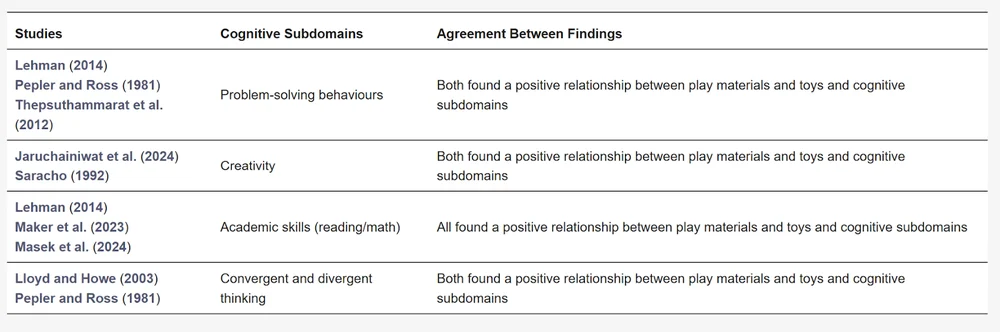
In other words, when learners are provided a space to explore without rigid instructions, they receive the opportunity to actively develop the cognitive skills that underpin learning across subjects. The key insight is that student-directed, exploratory activity is not a break from learning, but rather, a different sort of mechanism through which learning happens.
School Breaks: A Sandbox for Learning
Holiday breaks create a rare window where students are free from the constant evaluation and performance pressure of their academic programs. That freedom can go one of two ways:
- Endless passive screen consumption, or
- Meaningful exploration supported by curiosity and encouragement
The difference lies not in whether children use screens, but rather, how they use them.
Passive consumption — scrolling, watching without engagement, or relying on instant answers — does little to build thinking skills. However, interactive, inquiry-driven engagement — asking questions, testing ideas, reflecting — mirrors the same kind of benefits researchers have seen in unstructured play. Breaks complement this kind of learning as students face no rush to cover material, mistakes carry no penalty, and engagement is driven by curiosity, not grades.
Learning over breaks doesn't require any kind of fancy, complicated setup. It can be as simple as:
- Exploring a topic of interest
- Asking "Why?" and "How?" without worrying about correctness
- Connecting ideas across subjects
- Reflecting on what they've learned
The goal is not productivity — it's thinking, and at Grassroot, we've designed our learning platform specifically to support this kind of flexible, curiosity-driven learning. And there's no better opportunity to start than the unstructured time that holiday breaks provide.
Grassroot Makes This Possible
Our Tutors Are Always Available
Students can explore ideas whenever curiosity strikes — without the fear of being wrong or the feeling of being rushed. This psychological safety encourages risk-taking, an essential component of deep learning.
We Offer Personalized Guidance, Not Rigid Lessons
Grassroot adapts to each student's interests, background, and pace. That means exploration remains student-led, while learners can still feel supported and receive explanations that make sense to them.
Active Engagement Is Prioritized Over Passive Screens
Instead of aimless watching or scrolling, students interact with our tutors, by which they ask questions, explain ideas, and reflect on what they learn — the exact kind of cognitive engagement found in unstructured play.
The Perfect Holiday Gift
Ultimately, learning doesn't stop when school stops. It simply shifts form. Holiday breaks, when approached thoughtfully, are not interruptions to learning, but rather, opportunities for it to happen differently — and often more deeply. With the right support, unstructured time becomes fertile ground for confidence, curiosity, and independent thinking — the exact skills children need long after the break ends.
That's the kind of freeform learning Grassroot is built to support. And that's what makes us the perfect holiday gift.
Ready to give the gift of curiosity-driven learning? Explore Grassroot this holiday season and discover what learning feels like when it's driven by genuine curiosity. Start learning →
Sources
Cankaya, O., Martin, M., & Haugen, D. (2025). The relationship between children's indoor loose parts play and cognitive development: A systematic review. Journal of Intelligence, 13(5), 52. https://doi.org/10.3390/jintelligence13050052