The first term that comes to mind for many of us when hearing the word learning is, "thinking". Thinking appears inseparable from learning. We think about facts, formulas, abstractions, and ideas as we seek to learn about the world around us.
But for many of us – especially younger learners delving into complex subjects like advanced math, science, or test prep — learning isn't just cognitive. It's emotional.
Students don't just have to learn knowledge to solve problems; they must also feel safe when grappling with the learning process. They require encouragement when they're stuck. They need to know that the feeling of confusion is not a failure, but rather, a step toward mastery.
In an age in which AI's role as a learning partner has become increasingly prevalent, this emotional dimension matters now more than ever.
Parents and teachers often lament how most AI learning tools spit out answers quickly, stripping students of the chance to develop confidence and persistence – traits that are inseparable from quality learning. In fact, multiple long-standing studies have demonstrated that when students lack these qualities – when they feel judged, rushed, or ignored – not only do they find their learning progress impeded; they begin to dread the process of learning itself.
On the other hand, when students feel understood, encouraged, and supported, their academic outcomes improve dramatically. AI can either amplify a student's feelings of frustration or be shaped into a supportive companion. Ultimately, it comes down to how AI tools engage a learner's emotional experience – not just their academic performance.
Emotional Support — A Gamechanger in Learning
A growing body of educational research shows that emotions like confidence, anxiety, and motivation aren't side effects of learning; they are instrumental to the process, and without them, learning quality suffers.
In few arenas is this more apparent than in math, a subject that has evoked dread in billions of students, likely going back to the age of the Sumerians. Math isn't the only subject that's known to cause anxiety in students, but because of the way in which it is often taught – focusing on objective right and wrong answers – it lends itself to immense analysis of how anxiety affects performance.
Mark H. Ashcraft and Kelly S. Ridley, in a chapter in The Handbook of Mathematical Cognition, delved into a study by Ray Hembree, in which he explored the correlation between math anxiety in students and other variables such as their enjoyment of the subject. That correlation table is shown below.
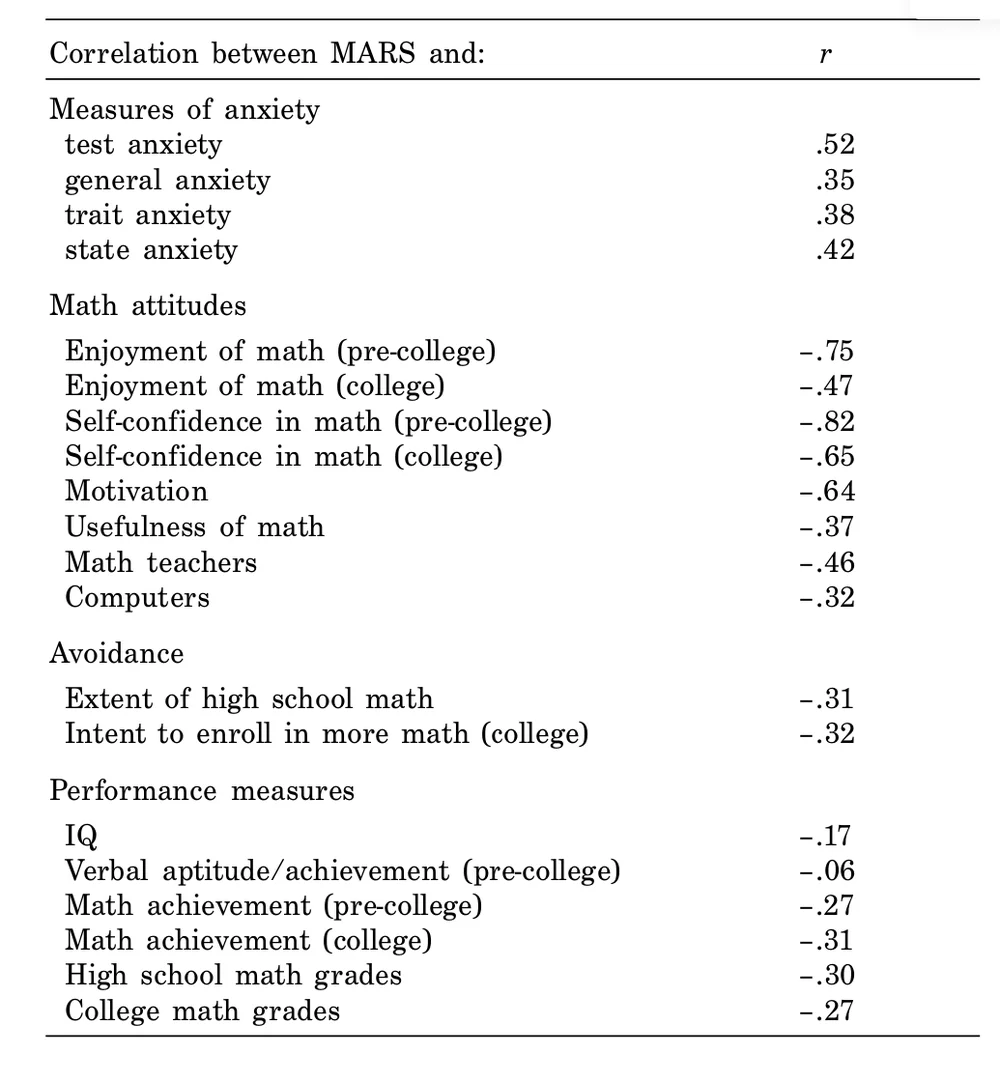
It's not a big shocker that students who experience math-related anxiety tend not to enjoy the subject, as evidenced by the -.75 and -.47 r values shown above. Seeing, however, that such anxiety is not only a predictor of lower grades and reduced achievement, but also a hallmark of impaired confidence, it's difficult to overstate just how much a student's lack of confidence in a subject can affect their learning at a holistic scale.
On the flip side, Psychologist Carol Dweck, in her landmark book Mindset: The New Psychology of Success, sought to distill her observations of a wide assortment of students who exhibited what she referred to as a "growth mindset", writing that:
"Instead of plunging into unthinking memorization of the course material, [these students] said: 'I looked for themes and underlying principles across lectures,' and 'I went over mistakes until I was certain I understood them.' They were studying to learn, not just to ace the test. And, actually, this was why they got higher grades – not because they were smarter or had a better background in science."
— Carol Dweck, Mindset: The New Psychology of SuccessWhen students feel emotionally secure in learning, the process becomes less of a chore and more of an experience they actually enjoy. In other words, safe learning encourages more safe learning. When students feel it's okay to make mistakes, they are more likely to try again, reflect, and ultimately grow throughout their educational experiences.
Grassroot: Emotionally Intelligent Learning
Anxiety in learning is a longstanding issue, but at Grassroot, we're committed to combating this roadblock to ensure a healthy, productive learning experience in each of our users. That's why we've designed our AI tutors with emotional needs at the center of the learning experience – not as afterthoughts, but as core principles.
Here's how that works in practice:
1. Always Available, So Learners Never Feel Alone
One of the most frustrating moments anyone can experience in learning is the feeling of being stuck alone. When a student hits a difficult problem and can't get help, frustration builds, and this can harm future learning efforts.
Our tutors are available 24/7, so students never have to stress over prolonged learning roadblocks. They can ask, retry, rethink, and talk through difficult moments in real time, all at their own pace.
2. Morale Boosts, Not Just Correct Answers
Learners don't need an AI that simply corrects their errors — they need one that encourages them. That's why whenever our students struggle, our tutors offer supportive responses:
- Positive reinforcement
- Scaffolded hints
- Explanations tied to prior steps
This methodology has been aligned to build up a student's motivation and persistence — not just their accuracy.
3. Personalized Connections: Tying New Topics to What's Familiar
Learning becomes less threatening to a student when they realize they have a connection to the topic.
Tutors at Grassroot connect new ideas to each student's own experiences and prior knowledge. Rather than presenting abstract math symbols or physics laws in isolation, our tutors relate concepts back to things the student already understands – from basketball to music, and everything in between. This reduces anxiety and builds a bridge of familiarity, enhancing both confidence and comprehension.
4. No Judgment: A Safe Space to Try and Fail
The foundation of emotional safety is being able to simply feel unjudged. Many students say they hesitate to ask teachers or peers for basic questions out of the fear they may be bothering someone else, or worse, the perception of being "dumb".
This is why the quality of being non-judgmental is inseparable from each of our tutors. Students can explore ideas without fear, and they can be wrong without shame. It is this very freedom to experiment that is essential for deep learning.
5. Our Tutors Themselves
There's a reason why our tutors take inspiration from some of the greatest minds in history. Isaac Newton, Marie Curie, and Charles Darwin all once grappled with the unknown throughout their journeys toward mastery of their respective fields.
The naming of our tutors isn't just a fun, stylistic choice. It reassures our students that learning is a journey, and that even the greatest of their fields struggle.
By standing on the shoulders of greatness, however, we're enabling our students to make that jump from "I'm stuck" to "I get it, and now, I'm growing."
Emotional Safety First, Then Mastery
In the rush to apply AI to learning, it's easy to focus only on accuracy, speed, and correctness. But research — and the lived experiences of students — tell a deeper story: emotional support matters just as much as cognitive guidance. Students should not only get the correct answers; they should feel safe learning.
At Grassroot Academy, we aim for both facets of the educational experience because true learning happens only when a student feels confident enough to keep trying.
Ready to experience emotionally intelligent tutoring? Try Grassroot Academy today and discover what learning feels like when you're truly supported. Start for free →
Sources
Ashcraft, Mark H., and Kelly S. Ridley. "Math anxiety and its cognitive consequences: A tutorial review." The handbook of mathematical cognition (2005): 315-327.
Hembree, R. 1990. The nature, effects, and relief of mathematics anxiety. Journal for Research in Mathematics Education, 21, 33–46.
Dweck, Carol S. Mindset: The new psychology of success. Random House, 2006.